Google Cloud, Google Workspace, Cloud Platform Services, AI

Three people, same company, same Monday morning. One Googles stuff. One checks TikTok. One just asks Gemini.
They’d all call it searching. The word stays the same, but the experience is changing.
Twenty years of blue links
For roughly 20 years, searching online meant typing a few words into Google and getting a list of websites back.
The genius of Google’s original system was PageRank. It ranked results based on how many other pages linked to them. More links meant more trust. It worked really well, and Google grew from a university project into one of the most used tools in human history.
The mental model was that information lives on websites, Google knows where the websites are, you click through, and find what you need. For most questions, that was enough.
The model assumed you knew how to translate what you needed into a short keyword string. Best restaurant Prague. How fix leaky tap. Q3 budget template. You weren’t describing your problem but converting it into terms the system could process.
This worked well enough that most people didn’t question it. That is, until a generation came along that never learned to do it that way.
The generation that searches differently
In the summer of 2022, a senior VP at Google made a striking public admission. About 40% of young people, when looking for somewhere to eat, skip Google entirely. They go to TikTok or Instagram instead.
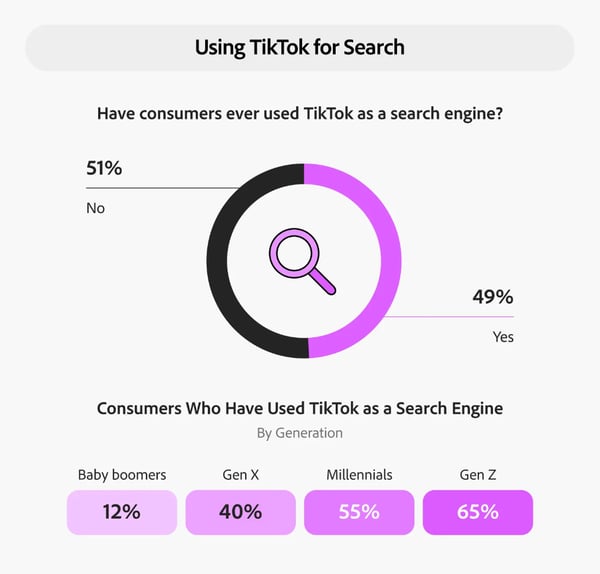
According to Adobe research, TikTok is now used as a search engine by 65% of Gen Z, 55% of millennials, and 40% of Gen X. That adoption has grown nearly 20% in just two years. By 2026, 49% of US consumers have used TikTok as a search engine.
 Source: Adobe
Why? Because they don’t want a list of links. They want to see the restaurant. They want someone who actually went there to look into a camera and tell them what the food was like and whether it was worth the price. They’re not looking for the most SEO-optimized result. They’re looking for the most human one.
It’s about more than platform preference. It’s about trust, and it’s about format. Gen Z grew up knowing that the top Google result is often written for an algorithm, not for them. A short video from a real person who tried the thing feels closer to the truth, even if it’s sometimes less accurate.
But to be fair, Gen Z still considers Google more reliable. They just don’t always find it more useful. That distinction matters.
YouTube has been the world’s second-largest search engine for years, with 2.5 billion monthly active users. Reddit has become the go-to destination for honest, unfiltered answers, it has risen to the #2 search destination in Europe. Amazon now handles the start of 52% of all product searches, bypassing Google entirely for anyone who already knows they want to buy something.
Search is now fragmented into at least six distinct behaviors: traditional (Google), video (YouTube), social (TikTok, Instagram), AI-assisted (ChatGPT, Gemini), e-commerce (Amazon), and visual (Google Lens). Different people, different questions, different platforms.
Google stays, but the way we search is changing
It’s easy to read all of this as a story about Google in decline. There’s more nuance to the data.
According to the Datos State of Search Q1 2026 report, which tracks tens of millions of real desktop users across the US and Europe, Google still holds 92–94% of desktop search in the US and around 95% in Europe. People still run roughly 100 Google searches a month. That number hasn’t dropped.
What has changed is how people search. Queries are getting longer and more conversational. Six-to-nine-word searches are growing. Shorter searches are staying stable — people aren’t replacing short queries with long ones, they’re adding longer, more specific questions on top. Best gym in Berlin is still a search, but so is gym in Berlin with a pool that’s open before 7am and doesn’t require a long contract.
Zero-click searches (where someone gets their answer directly on Google’s results page and never visits a website) are actually declining, falling from 24.5% to 22.4% in the US between December 2025 and March 2026. Organic click-through rose from 42% to 44.9% over the same period.
And AI tools? Their desktop share grew from 1.3% to 1.65% in one year. Still under 2%. The narrative about AI eating search whole hasn’t matched reality, yet. But the growth is consistent and accelerating, and Google’s own AI Mode, powered by Gemini, hit 1 billion monthly users, with queries doubling every quarter.
What Google is actually building
At Google I/O 2026, Google announced what it’s calling the biggest change to Search in 25 years. For the first time since the late 1990s, the search box itself has been redesigned. It now expands as you type, accommodates much longer and more conversational questions, and accepts text, images, files, videos, and open browser tabs. All at once.
But the bigger announcements were what comes after the search. We’ve got:
-
Search agents. Google is introducing persistent background agents, not chatbots you talk to once and forget, but software that monitors topics, prices, news, and listings on your behalf, and sends you a summary when something changes. It searches for you.
-
Personal intelligence. Google now connects your Gmail, Calendar, and Google Photos to your search results. If you search for “project timeline template”, it already knows what kind of projects you run, what tools you use, and what you’ve looked at before.
-
Generative UI. For complex questions, Google now builds interactive responses on the fly (tables, charts, simulations) directly inside the results page. It’s not a list of links but an answer that’s shaped to your specific question.
Google is moving from finding information to understanding what you actually need and doing more of the work itself. And some studies suggest traffic referred from AI-assisted search converts significantly higher than traditional search. People who get answers through AI have already done their research. They arrive somewhere knowing what they want.
The same change, inside your company
The reason Google can now understand what gym near me doesn’t require a long contract (and give you a useful answer, in plain language, without you knowing exactly how to phrase it) is the same reason the Finance team can now describe a problem in ordinary language and have an AI agent understand it, investigate it, and draft a response.
The underlying change is the same. AI has gotten much better at understanding intent, not just keywords. At working with context, handling ambiguity, and reading between the lines of what someone typed and figuring out what they actually need.
For 20 years, using technology effectively required knowing its langugage. You had to know the right terms, the right syntax, the right way to phrase things so the system could understand you. Developers, analysts, and power users got more from technology than everyone else because of this, not because of some talent, but because they’d learned the language.
But these days, you can just describe what you’re trying to do, the way you’d explain it to a colleague. So it’s about removing the translation layer that has always been between people and the information, insight, or output they needed.
What this means for your team
Most teams are already using AI in some form. Someone pastes a document into ChatGPT. Someone uses Gemini to draft a first version of something. Sure, it helps, but it tends to be informal, ad hoc, and disconnected from the actual systems the team relies on.
The bigger opportunity is getting AI to work with your existing data and processes, not as a general writing assistant, but as something that understands your specific workflows and can take the manual work off your plate. The question is whether it happens with any structure behind it, or just informally, in ways that create more problems than they solve.
We’re not just saying this...
The teams we’re talking to now are in Finance, HR, Marketing, Operations — people who are already using AI informally and want to do more with it, properly. These teams don’t need a new cloud platform. They need someone who can listen to what they’re actually trying to do, identify where AI can take the manual work off their plate, and build something that fits into the way they already work, without requiring them to become engineers first.
That’s the conversation we want to have. Not about technology. About the tens of hours a month that should be going somewhere better.
If that sounds like your team, get in touch.